There are “great” Ferraris, and then there are Ferraris that feel like a bookmark for an entire era. The Ferrari 458 Italia is that second kind: the last big, clean-breathing, naturally aspirated mid-engine V8 Ferrari before turbocharging became the new normal. It’s fast, sure—but more importantly, it’s loud in the right way, instantly recognizable, and permanently imprinted on the car-nerd brain.

Why the 458 is instantly identifiable
Even if you don’t know a single spec, you know a 458 when it goes by. The stance is low and wide, the cabin looks tucked forward like it’s hugging the front axle, and the sides carve inward into those dramatic boomerang-ish intakes that make the whole car look like it’s inhaling the road.
Start at the back and you’ll find the signature flex: the center-mounted triple exhaust. It’s not just a styling flourish—it’s a calling card. Ferrari itself points to the heritage here: the triple pipes are a deliberate wink to one of the most worshipped poster cars of all time, the F40. Translation: the 458 is basically saying, “Yes, I know my ancestors were unhinged. I’m keeping the tradition alive.”

Then there are the taillights. Ferrari has played with shapes over the decades, but the circular taillights are one of those “Ferrari DNA” cues that just works—especially at night, when two glowing red rings per side are all you need to identify the brand before your brain even catches up. On the 458, they sit high and proud, like the car is wearing earrings.
The signature sound: a naturally aspirated 4.5L V8 that lives for revs
The 458’s engine is the main event: a 4.5-liter naturally aspirated V8 that spins to a headline-grabbing 9,000 RPM. No turbos, no waiting, no “it comes on boost”—just instant response and a rising, tightening howl that gets sharper the closer you get to redline.
If you’ve ever heard a 458 in person, you remember the texture. Down low it has a crisp bark, but as the revs build it turns metallic—almost like a giant instrument being wound tighter and tighter. The reason is simple: without turbochargers acting like mufflers (turbos soak up exhaust energy), the sound you get is raw exhaust pulse and high-frequency mechanical intensity. It’s one of the clearest “you are hearing combustion” supercar noises of the modern age.
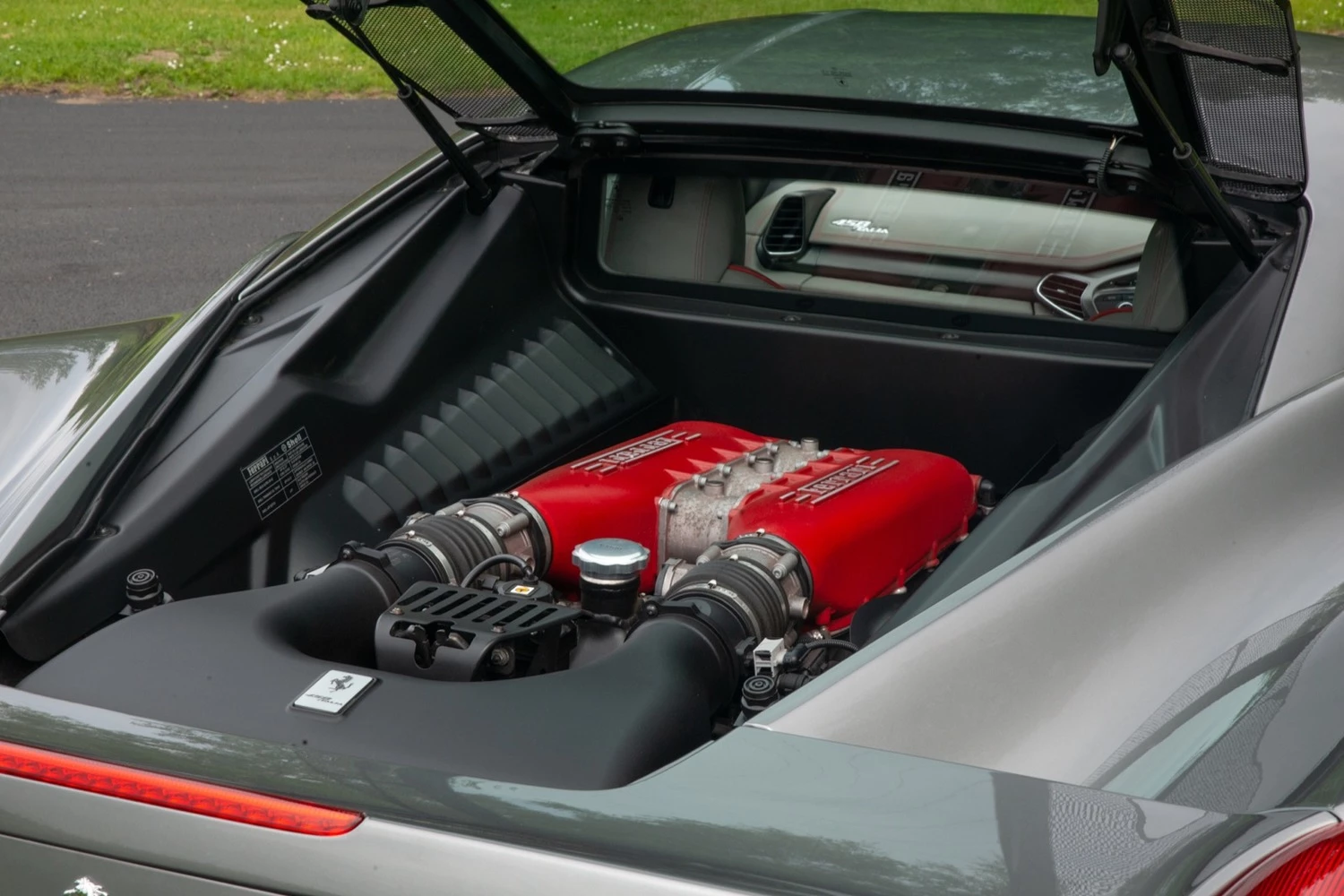
And yes—the name really is that literal. 458 breaks down into 4.5 liters and 8 cylinders. It’s refreshingly honest, like Ferrari briefly decided to label a supercar the way you’d label a snack: “contains V8, may cause grinning.”
A quick sound “translation” for non-audio nerds
- Throttle blip: a sharp, clean crack—like snapping a ruler on a desk.
- Midrange pull: a smooth, rising wail that feels “connected” to your right foot.
- Near redline: a high, tight scream that turns heads even when people don’t care about cars.
- Lift-off / overrun: light pops and crackles as unburnt fuel ignites in the exhaust—normal on performance tuning, and very “supercar theatre.”
The aero trick you can actually talk about at a meet
The 458 isn’t just pretty—it’s sneaky clever. One of the coolest nerd-facts is up front: the 458 uses deformable (aeroelastic) front winglets. In plain English: small flexible aero bits that can change shape under airflow load. At lower speeds and during cornering, they help generate downforce. At higher speeds, they can flex to reduce drag so the car isn’t fighting the air as hard on straights.
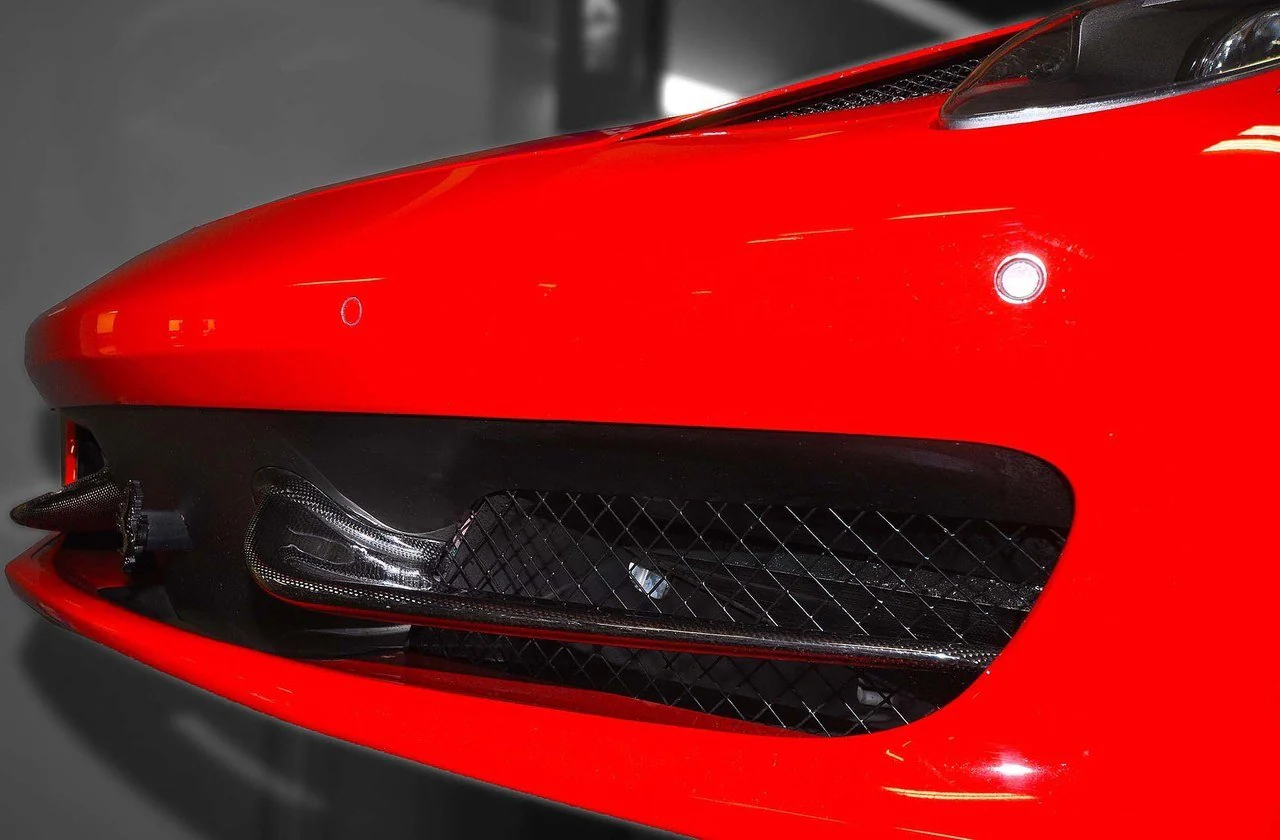
It’s also why the 458 looks like it has a purposefully sculpted “face.” The front end isn’t just styling drama—it’s airflow management. The underbody and diffuser work together like an upside-down wing, accelerating air underneath the car to create lower pressure and pull the car down. (That’s downforce: basically “extra grip made of air.”)
Pop culture: the 458 era was a full-on internet civil war
If you were around during peak car-forum times, you remember the debate: Ferrari 458 vs McLaren MP4-12C. One side argued the McLaren was surgically fast and technically brilliant. The other side said, “Okay, but the Ferrari makes me feel like I’m starring in my own action movie.” The 458 basically became the mascot for that argument: emotion vs. efficiency—and the V8 soundtrack was the mic drop.
It also became a greatest-hits car in racing games. The 458 is one of those “default supercars” that shows up everywhere because it instantly reads as Ferrari in silhouette, in sound, and in vibe. If you’ve ever driven one in a sim and immediately started upshifting just to hear it crack and snap between gears… yeah. Same.

Spotter’s guide: how to recognize a 458 in 5 seconds
- Rear view: center triple exhaust above a big diffuser; four round taillights total (two per side).
- Side profile: sharp, carved side intakes that look like a swoosh cut into the door line.
- Front end: wide mouth + sculpted splitter area; subtle aero details that look “engineered,” not decorative.
- At night: circular taillights that scream Ferrari before you even register the badge.
- By sound: a clean, rising NA scream—no turbo whoosh, no muted bass-heavy rumble—just high-rev intensity.
- Bonus trivia: “458” literally means 4.5 liters and 8 cylinders.
Quick spec cheat sheet
Model: Ferrari 458 Italia (Type F142)
Engine: 4.5L naturally aspirated V8 (F136 family)
Redline: 9,000 rpm
Layout: mid-engine, rear-wheel drive
Signature cues: triple center exhaust, circular taillights, sculpted side intakes
The 458 is one of those rare cars that works on every level: it’s a silhouette you can draw from memory, a sound you can identify with your eyes closed, and a trivia goldmine (name math, F40 tribute exhaust, clever aero, the whole “last of the NA V8s” storyline). If you’re the kind of person who enjoys being annoyingly correct about cars—congrats, this is your supercar.

Think you could spot one from a single photo, a rear-light glimpse, or a three-second exhaust clip? Put it to the test with Cardle on DailyCarQuiz—because the 458 is exactly the kind of icon that separates “I like cars” from “I immediately noticed the triple exhaust.”